
Finding Dublin Residents Through Records
No public source names every person connected with every Dublin address. The useful Dublin residents directory trail is narrower and evidence-based. A parcel card speaks to the tax owner and property. A deed records parties to a transaction. A voter tool checks an individual registration. A directory volume may place a named person at an address in its publication period. Each source answers a different question, so a match should be tested against another record rather than treated as a complete profile.
For a current property question, identify the county first, then use its parcel system. For a family-history question, begin with the date and the old address, then use the Columbus Metropolitan Library and the Dublin Historical Society. For a court or estate lead, select the court that has the case type. This order keeps a Dublin resident search tied to the custodian that actually holds the record.
- Use the city map or parcel source to identify the county behind the Dublin address.
- Search the county Auditor by address, owner name, or parcel number, and save the situs address and parcel identifier shown.
- Use the parcel number, legal description, party name, or recorded date in the Recorder index for a document trail.
- For one supplied name, check the official voter tool with the correct county and compare the returned details carefully.
- For an older household, consult library directories, maps, newspapers, and archival catalog entries before making a conclusion.
Note: A result can document one relationship, but a Dublin residents directory search needs a second source before the names should be treated as the same person.
Dublin Resident Record Offices
Dublin is principally in Franklin County, but it also reaches Delaware and Union Counties. The City directs association researchers to the recorder in the county where a neighborhood lies. That same jurisdiction check matters for property and recorded documents. The Franklin offices below are the main route for a Franklin County Dublin parcel; a Delaware or Union parcel needs its own county's offices instead. The fuller address sequence appears on the Dublin street directory page.
Franklin County Recorder
373 S. High St., 18th Floor
Columbus, OH 43215
614-525-3930
Franklin County Board of Elections
1700 Morse Road
Columbus, OH 43229
614-525-3100
The City of Dublin keeps its own administrative records through its public-records route. County offices hold the core parcel, deed, election, and court material. That split is why a request should identify the record class and the county, not ask an office to create a person list.
Dublin Residents Start With County
A Dublin mailing address is not enough to select a records office. The City’s Dubscovery map can search an address, street, owner, parcel, park, or subdivision and exposes County of Parcel Data with a county-link field. That makes it the practical first stop when a Dublin residents directory search begins with an address. Choose the county it returns, then move into that county’s Auditor and Recorder systems.
The distinction also protects historical work. An older document may use a township, a former jurisdiction label, or a postal name that differs from a modern Dublin address. Preserve the legal description and parcel information where shown. They identify land more reliably than a ZIP or a city label alone. The City’s annexation layer records effective-year information, so a present-day boundary should not be projected backward onto a historic source.
Dublin Parcel Records to Deed Trail
For a Franklin County address, the Franklin County Auditor Property Search is the correct first online tool. It offers owner-name, address, parcel-ID, subdivision and condo, map, and intersection routes. An address result supplies the parcel context that the Recorder needs. The Recorder does not index a street address as a dedicated field, so typing an address there skips the bridge that makes the deed search work.
| Auditor control | Use in a Dublin record search | Verified format or limit |
|---|---|---|
| Owner Name | Find a property record by an owner name | Separate owner-name mode |
| Address | Open a parcel trail from a physical location | Separate address-search mode |
| Parcel ID | Find one tax parcel or a partial sequence | Enter without dashes; wildcard examples are shown |
| Subdivision & Condo | Locate a recorded development context | Separate search route |
| Map or Intersection Search | Locate land visually before opening details | Map-based route |
A Franklin County Auditor property-search screen shows the navigation used to move from an address or owner into the parcel record.
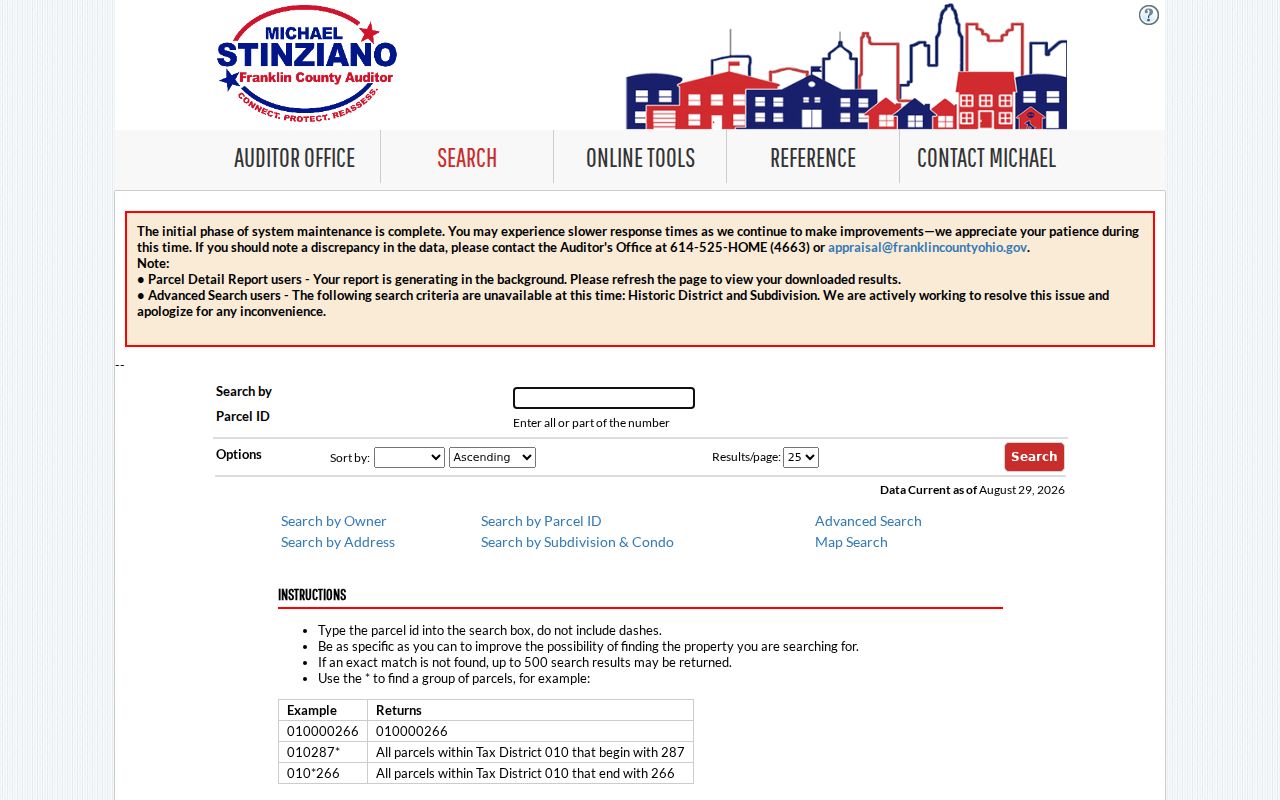
Use the returned parcel ID and legal description as the handoff to recorded documents, then read the live parcel card rather than assuming every field appears for every parcel.
- Parcel
- A county identifier for one real-property account.
- Situs address
- The physical location of the parcel.
- Legal description
- Lot, subdivision, or other land description used in recorded property documents.
- Index
- A finding aid that points to a record; it is not always the record image itself.
Dublin Voter Records by County
The official Ohio voter search asks for first name, last name, and county. Its tips also advise trying a derivative first name, a former surname, or an earlier Ohio county address. For Franklin County, the county portal is another individual confirmation route. A returned record may provide registration and precinct or polling-place context. It does not reveal ballot selections, and it is not a browseable list of every person on a street.
There is also a limited historical channel. Ohio’s DATA Act archive says county boards create daily registration snapshots at 4 p.m. and keeps files for at least 22 months. It reports more than 60,000 county files at a time, which explains its batch-download design. Those files are a time-bound public-records resource, not a substitute for careful individual verification or for protected-address rules.
A Franklin County voter-search interface is the county-level route for a supplied name.
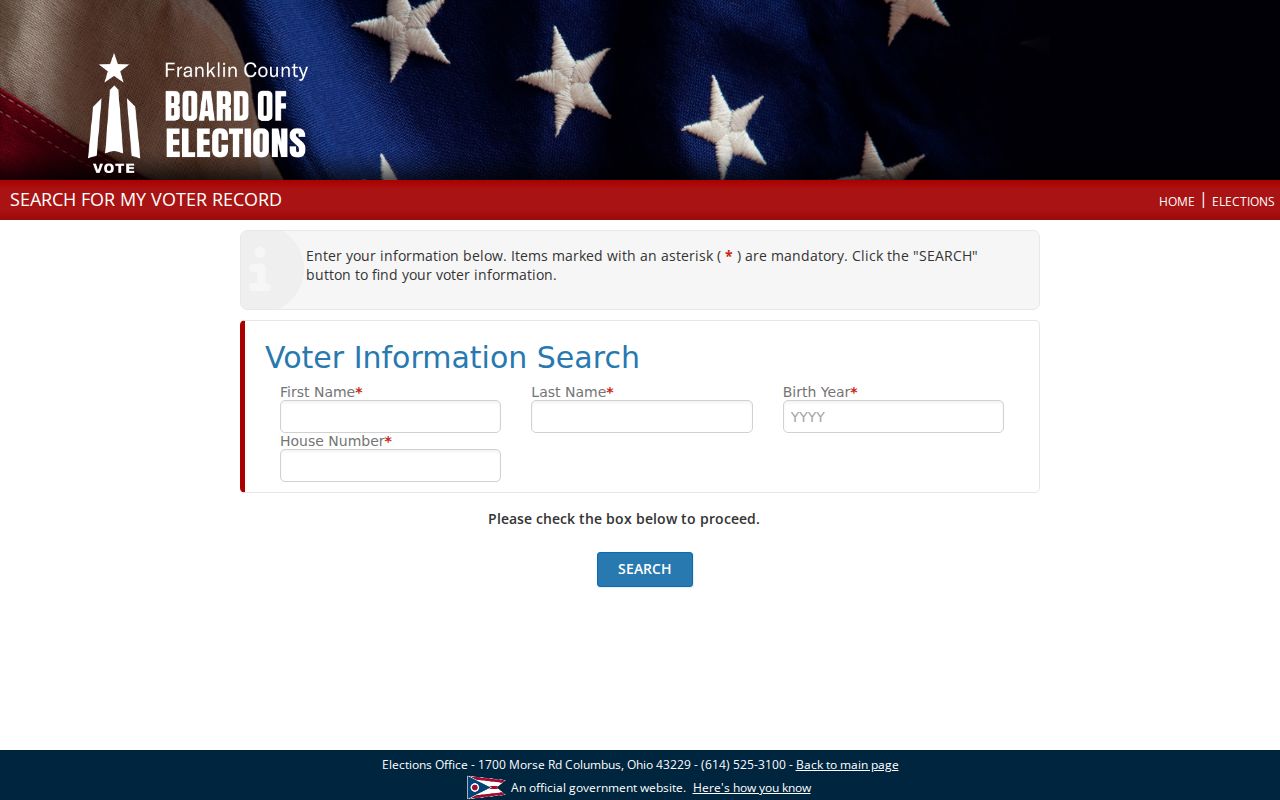
Use the correct county in the form and compare the result with a separate record before treating a Dublin resident connection as established.
Note: Participation history can show whether someone participated in an election, but it never identifies the selections made on a ballot.
Dublin Current Resident Sources
Current sources in a Dublin residents directory do not all describe the same people. The property application is useful for owner-of-record and parcel questions. The Recorder lists parties to recorded instruments. Voter tools confirm a supplied person's registration. Court indexes describe parties to cases. The City’s neighborhood resource page describes association structure and recorder links, but it does not publish a citywide member list. Matching the source to the question keeps the record trail honest.
| Dublin source | What it can confirm | Custodian | Access route |
|---|---|---|---|
| Property parcel record | Tax owner, situs, parcel, and displayed transfer facts | County Auditor | Public property search |
| Recorded instrument index | Parties, date, document, and legal-property reference | County Recorder | Public search or counter |
| Individual voter search | Registration, precinct, and polling-place context | Ohio SOS or county Board of Elections | Name plus correct county |
| Court docket | Named party in a particular case | Appropriate court clerk | Jurisdiction-specific index |
| Neighborhood records | Association governance or recorded declarations | City and county Recorder | City resource page and county record route |
Official records are issued or maintained by a public custodian and let a reader check the underlying record. Commercial people-finder products are a separate category that can combine data from different sources and may have stale or mismatched results. When the two conflict, return to the office that holds the original record.
| Official custodian trail | Commercial compiled profile |
|---|---|
| Shows a defined record, date, and keeper. | May combine records with different dates and matching rules. |
| Supports a correction request to the responsible office. | Does not replace verification with the original custodian. |
Dublin Court Records for a Name
Court records can help distinguish a named person when the court, case date, and other details line up. Franklin County Municipal Court has its own records search for municipal matters. Common Pleas, Domestic Relations, and Tenth District appellate docket information is in Case Information Online, often called CIO. Probate maintains a separate General Case Search for estates, guardianships, name-related matters, trusts, and marriage-license work. A no-result in one system says nothing about the others.
The Municipal Clerk form supports last name, first name, middle name, date of birth, company name, party type, case number, ticket number, case type, year, and status. It requires either a case or ticket number, a last-and-first-name combination, or a company name. Start narrowly. Similar names, old addresses, sealed material, and redactions can all make a docket result a weak match without another record.
The Franklin County Municipal Court Clerk search displays the filters used to narrow a case query.
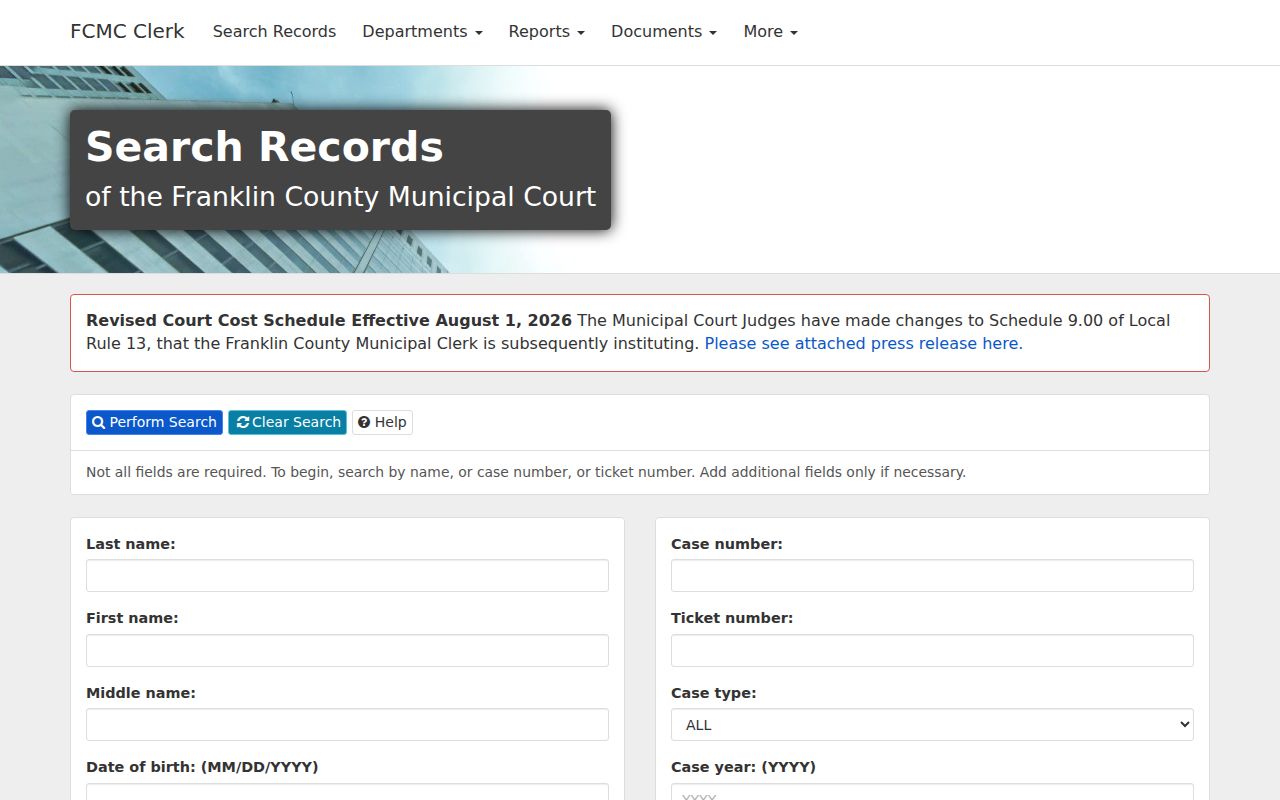
A docket is an index to a case and its events. The official file and the clerk’s access rules control any copy request.
A Franklin County Case Information Online screen is the separate route for Common Pleas, Domestic Relations, and appellate docket information.
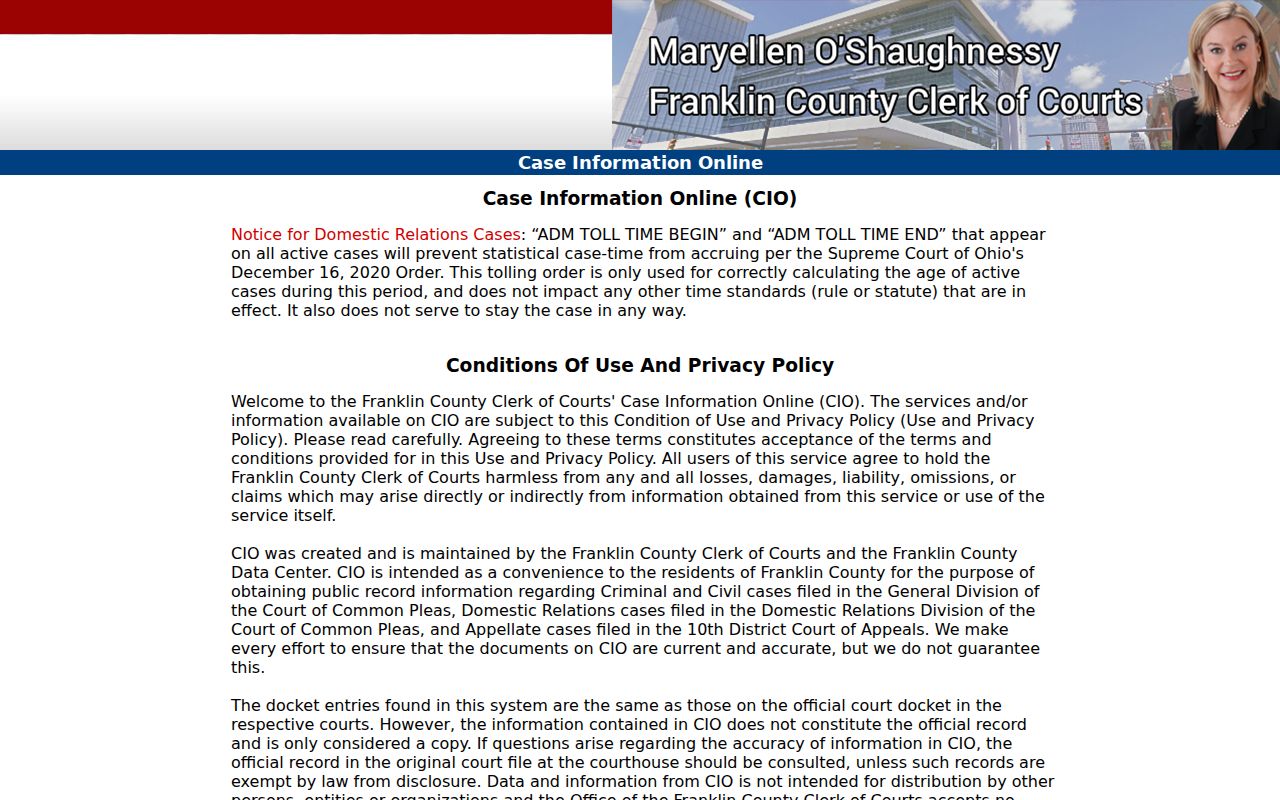
The CIO notice treats the online docket as a convenience copy, so an official file should be checked when an exact record matters.
Dublin Requests When Searches Stop
When a portal does not expose a needed existing record, send the request to the office that holds it. Dublin uses JustFOIA for City public-records requests. The Recorder handles recorded-document copies. A court clerk controls its court file, and the Board of Elections has its own public-records channel. Under the Ohio Public Records Act, records held by a public office are generally available for prompt inspection during regular hours and copies at cost within a reasonable time, subject to exemptions.
A focused request gives a custodian a record category, a parcel or case number where known, a street address or name, and a date range. Ask for the nonexempt portion and the legal basis if material is withheld. The law does not require an office to investigate a person's history or build a new list from separate files. For historical Dublin material, CML consultations and the Dublin Historical Society catalog are often the better fallback than an agency request.
Dublin Protected Address Limits
A missing result can be the right outcome. Ohio Safe at Home participants may use a substitute mailing address and can protect a home purchase from appearing under their name and address in county tax and public records. Court files can be sealed or redacted, and some probate, juvenile, vital, medical, and motor-vehicle information is restricted. A public index does not override those limits.
Lawful personal use. Dublin record searches are for legitimate personal, family-history, estate, civic, or safety questions. Never use an address or filing to stalk, threaten, harass, impersonate, or harm anyone.
Ohio law requires an office to release nonexempt portions where applicable, not to expose data made confidential by another law. If an eligible person needs address protection, the Ohio Safe at Home program is the official route. A protected result is not a lead to work around.
Dublin Historical Resident Directories
Historic resident directories answer a dated address question, not a current-location question. Columbus Metropolitan Library holds city directories from 1841 and street-address sections from 1911, as well as early Franklin County telephone material. A volume can connect a person and address for its own publication period, sometimes with an occupation or business notation. It does not prove title, list every person in a home, or guarantee that every Dublin year is represented.
The CML Local History and Genealogy division offers Main Library browsing, consultations, online help, obituary requests, maps, census resources, and house-history guidance. Dublin-specific photographs, papers, maps, property records, newspapers, yearbooks, and oral histories are cataloged by the Dublin Historical Society. The collection-level detail matters. A catalog record should be checked for its creator, date, place, and access terms before a name is used as evidence.
The deeper directory shelf, including how to read entries and trace a household year by year, belongs on the Dublin city directory page.
Dublin's 1804-1913 Recorder Story
Franklin County’s historic deed-index path covers 1804 through 1913. The Recorder guide directs a researcher to choose the historic deed index, select grantor or grantee and a time period, browse surname letters and pages, then use the cited volume and page. Modern deed indexing begins January 2, 1914. Mortgage indexing begins January 7, 1970. The change in search method is a records-history fact, not proof that a property trail ended.
Some county records were destroyed in the 1879 fire, though the Recorder says most were reconstructed. That history explains why an older chain can have a gap or a difficult index reference. A Franklin County Recorder advanced-search screen shows the newer search environment, including party, date, document, book/page, OCR, and legal-description options.
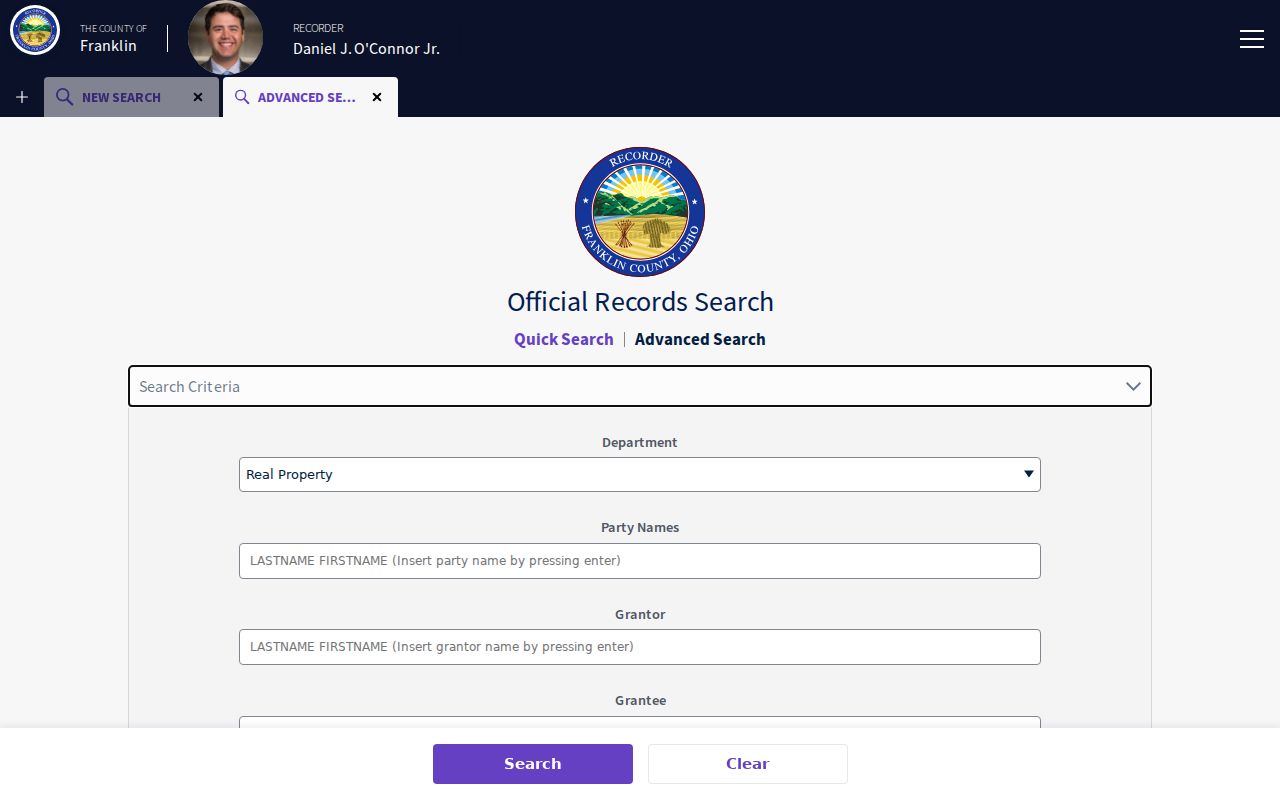
For an address, take the Auditor parcel or legal description into the Recorder search first. For archival deeds, follow the historic grantor-grantee and volume-page route or ask the counter for help with the cited reference.
Note: An instrument number, book and page, or microfiche reference identifies a record’s era and location, not the current status of the people named in it.
Dublin Cemetery and Archive Leads
For family-history work, the Dublin Cemetery Database is a local name-search route. Its configured fields can include burial location and veteran or service details. It is a source for a burial lead, not a present-resident source. A missing entry also is not proof that a person was never buried locally, because some local burial grounds are unmarked or not fully cataloged.
The Dublin Historical Society offers an online catalog and Dublin Memories material, with original materials available by supervised appointment. Its early-1800s-to-present archive can add family papers, street and home photographs, surveys, plats, church or school material, and oral histories to a record trail. Pair those local sources with an identified deed, directory entry, obituary, cemetery result, or court record rather than letting a single item stand alone.